Thursday, June 23, 2011

Ain't No Cure for the Summertime Blues


Been feeling somewhat low and at odds with myself lately, which pretty much means I haven't been writing as much as I need to. I don't mean 'need' as in needing to get work done, I mean 'need' the same way an athlete needs to work out in order to feel fit. But that's largely due to the start of summer vacation. Okay, full disclosure, it's also due to my near-obsession with reading the first four books of the Game of Thrones series twice (that's roughly 6,000 pages in the past two months) before the fifth book comes out on July 12th and reading The Inferno for my work with Home-Schooled Teen.

Mostly, though, it's the beginning of summer that's thrown me off my stride, as it does almost every year. It's difficult to make a smooth transition from having my days to myself to having two kids hanging out at home. This year, we had planned to be away from home for most of the summer on a cross-country trip. Unfortunately, the rising cost of gas increased the cost of that trip enough that we've postponed it until next summer. So the kids are home and decided they didn't want to do summer camps this year. Which means they're home. Full time. They're good kids and pretty used to their mom's crazy insistence on being left alone for vast stretches of time as well as her lion's roar when she gets interrupted while she's writing (I do allow interruptions in the case of life-threatening situations, if blood has been spilled, or the house is burning down. Other than that, you take your life in your hands if you come into my space while I'm working). As much as they leave me alone, it's still difficult to write when I know they're there. So I haven't been. And it's starting to show.

Which means that it's time to commence the Emergency Summer Plan of Action: waking up at 4 am to work on the novel for a few hours before everyone else's day gets going.

I've done it before. Several years ago, I finished up another novel by getting up at 4 am for three months straight, and it was wonderful. It wasn't so much the blissfully uninterrupted hours of writing time, it was sitting down to write day after day and observing the ebbs and flow of my creative process. There were productive days and non-productive days. Days when the writing flowed and days when it was stuck in the mud. The work responded to that schedule, too. It seemed to like the extra attention and the additional commitment I was making to get that book finished. The other thing I noticed, when I get up at 4 am and start writing immediately, I don't get that niggly, annoying half hour of self-doubt while my conscious brain gives up the idea that it's in control. When I start writing at 4 am, my conscious brain is still asleep and doesn't notice that anything's going on until I'm half an hour into the work and then it takes a look and goes, okay, everything's under control.

So back to 4 am wake-up calls while I get this novel finished.

There are other things on the summer docket. I'm putting together an Etsy store to sell my cards and pins. Fingers crossed I'll have that going in the next month. I'll make an announcement here when that happens and direct everyone to my store.

The big excitement at the beginning of July is the arrival of my mentor, Alice la Plante's first novel in bookstores. Alice is an amazing writer and this book gotten some serious buzz - it's the #1 summer Indie Bookseller's pick - finger's crossed it'll do great. The book is about a woman with Alzheimer's who is accused of murdering her next door neighbor and can't remember what she was doing, just that there was blood on her hands and the police arrested her. You should definitely go look for Turn of Mind by Alice la Plante and help it become a best seller.

Tuesday, June 14, 2011

In Defense of Fantasy


(Quick note: I started this post back in April, then got sidetracked by reading the rest of the George RR Martin series and working on my own novel, as well as some family stuff that needed to get done, the start of summer vacation, and plans for the arrival of a new puppy. Since I started this post, I have finished the series and am now almost done with my second read-through of it (there were some things I wanted to investigate and figure out a little more while they were still fresh in my mind) in anticipation of the release of the fifth book in the series on July 12th.)

For the past week, I’ve been indulging an ancient passion of mine: reading fantasy. I picked up A Game of Thrones after watching the first episode of the HBO miniseries last Sunday night, and was completely in thrall to the book from the first chapter to the last. It’s one of the few books I’ve read in the past several years that I have devoured, pretty much bringing all other work to a halt so I could swallow it in one gulp (I even took my car in for service just so I could read for two hours without feeling guilty that I wasn’t getting anything done – the car needed the work, but still…). It’s a pretty big book to take in that way, more than 600 pages long, and Thrones is just the first of a series. It took me two and a half days. I finished this morning and have already started in on Book Two: Clash of Kings. Yeah. It’s that good. Sweeping. Epic. Told from multiple points of view with a cast of thousands. And the action never stops from page one onward. I can’t even imagine the mind that could conceive of a plot this elaborate and intricate and able to keep everything straight. And the writing is beautiful.

Which brings me to the real point of my post. Give me a moment while I climb up on my soapbox. Okay. Here it goes:

I don’t understand the bias against fantasy (or any genre, for that matter) in most creative writing programs. Many of you, if you’re regular readers of my blog, will remember the letter I wrote to Neil Gaiman that he posted on his blog about my experiences in creative writing programs and their response to genre writing. The bias is that serious writers don’t write fantasy because fantasy can’t explore the depth of the human condition as deeply or as truthfully as realistic (ie; literary) fiction can. Any fantasy writer is, by virtue of writing fantasy, not a good writer.

Which, I think, is a load of hogswallop.

I was twelve when I discovered my dad’s collection of classic science fiction/fantasy – Asimov, Bradbury, Heinlein, Clark, Le Guinn – all the biggies were there, and I read most of them. The first book I read, after I was done with fairy tales, horse stories and a brief, though thoroughly embarrassing, stint with romance novels (though, in my own defense, I probably learned a LOT about how to write a good sex scene from those novels, good enough to get one of my grad professors to write ‘Hot!’ in the margin of my novel)…but what I consider to be my first REAL book was Fahrenheit 451, Bradbury’s dystopic book burning classic. I went on to read Stranger in a Strange Land (and learn the meaning of ‘grokking’ something), 2001, I Robot and the Foundation Trilogy, Dune, Andromeda Strain, just about anything I could get my hands on. I listened to the Hitchhiker’s Guide to the Galaxy so much I developed an English accent (my dad, thank you so much! decided to tape the BBC radio play when it was first broadcast on NPR back in 198?, ’81, I think) and I have first edition copies of all the books in the series except the first one (darn!).

At one point, I wanted to be write fantasy, but I gave it up because I realized my ideas just weren’t good enough. Yes. You heard that right. I turned to literary fiction because I couldn’t write fantasy. There’s my deep, dark little secret. I am a failed fantasy writer.

While I think the true source of the bias lies in the fact that fantasy writers have an easier time making money from their writing than literary writers, I’ll set that aside for the moment in order to comment on why I think the quality argument is a bogus one and how the genre of fantasy is a more legitimate descendant of western literature than literary writing, and one with far deeper roots.

One of the reasons I think fantasy is seen as a facile is that it is closely aligned with fairy tales, myths, the fantastical stories we read as children. Just as the stuffed rabbit we couldn’t go to sleep without embarrasses us as adults, so to, the literature we adored as children does not seem to be the stuff serious adults who want to be taken as serious intellectuals should be reading.

I’ve read a lot of the western canon’s foundational work – Gilgamesh, the Odyssey, the Aeneid, the Inferno, and I read a lot more classic work than I do contemporary fiction (there, another deep dark admission). Dostoyevsky, Austen, Elliot, Kafka, Woolf, etc. My favorite time period is fiction written between the two world wars. Most classical work, at least until the industrial era, has some kind of fantastical element to it. In fact, I think a lot more work that has stood the test of time has fantastical elements than doesn’t.

Now, I haven’t done any research on this, and it’s a developing theory of mine, but I think the insistence on a strictly literary genre (and yes, it is a genre) of fiction has come about with the rise of the middle class, especially the educated middle class. The middle class is extremely concerned with manners and the correct way of doing things. Think about Austen and the concern about marrying correctly – who do you think she was writing for? So the rise of literary writing seems to me, to have come about with the rise of an educated middle class, concerned with seeming to be smart, savvy, ahead of the curve, and vitally concerned that others recognize these qualities in them. Hence the need to denigrate the things that might have been enjoyed as children, like fairy tales. Sophisticated people do not listen to ghost stories or believe in knights in shining armor. Horrors if a dragon should show up! Or a robot!

But the insistence that literary fiction somehow has the corner on a true reflection of culture or is somehow deeper or more meaningful because it shows us as we truly are drives me nuts. I love Andre Aicman. His Call Me By Your Name is one of the most amazing works of contemporary fiction I’ve read in a long time. However, when I read his latest novel, Eight White Nights, I found myself wondering who on Earth actually acts like this? Who thinks like this? Yes, it’s rendered in excruciatingly accurate and realistic details, but really, I know very few people who imagine standing on the street gazing up at the lighted window of a woman they’ve just broken up with within hours of meeting said woman, or who are so enamored with the future past tense of their lives that they forget to live the present moment. Is it a valid point? Sure. I’m positive there are actually people who think like this, but, you know what? They’re not very interesting to read about for several hundred pages.

Another problem contemporary writing has is an inability to deal with the present moment. In a Paris Review interview, Ray Bradbury said that mainstream writing ignores the major ideas of our time. “The critics are generally wrong, or they’re fifteen or twenty years late,” he said. You can see this played out in the tendency for literary fiction to place stories in the near past, at a time when computers, cell phones and the internet were non-existent. Ask any writer about the “cell phone” problem and, most likely, you’ll get a list of ploys that writer has used to get around the ways in which ready access to a phone would solve a necessary plot complication. The phone is lost. Cell service is spotty. The phone simply isn’t turned on. The battery is low. The phone’s gotten dropped in a toilet and is no longer working.

Seriously, wouldn’t it be simply easier to put your characters on another planet?

But really, what those who denigrate fantasy miss is that the best fantasy writing is allegory. It treats the issues of our day in a way that we can hold them in our hands and examine them up close. Genocide? War? Tyranny? Evil? The just use of political power? These are all issues that exist in our contemporary world, but they are difficult to transform into realistic novels without becoming preachy or pedantic or, worse, boring and issue-driven. But fantasy can deal with them in ways that are interesting and draw direct comparisons to our real world. One of the things I admire about the George RR Martin series is how he shows war from all sides – one side’s murder is another’s self-defense. Wars (and political careers) turn on a decision made in the heat of the moment. The series is an extensive contemplation of what justice means. And it’s fun to read. And it has dragons.

And it is the legitimate descendant of the foundations of western literature in a way literary fiction is not. I am reading The Inferno right now. At every turn, there is a monster or a mythical creature or some character out of legend. It is tied into our ancestral memory of sitting by the fire, listening to the stories of heroes. It taps deep into our subconscious to reveal a deeper truth about ourselves and who we are. Which is probably why, after more than 700 years, it is still being read.

We abandon these myths and folktales at our peril. We impoverish our literature by insisting that the only true literature, the only legitimate form of expression, is that which renders our world in realistic detail. Because it denies the essential fact of writing – writing, by its very act, transforms our world into symbols. It isn’t realistic no matter what we do. No matter how realistically a writer renders a world, there is still the fantastical, alchemical process of taking these words you are reading and transforming them into pictures in your mind.

Sunday, May 15, 2011

Post of Quotes


Here are some of my favorite quotes about writing in no particular order:

‎"Whatever I think is radical and interventionist and different about my work in terms of American literature...a book has to work as a book for someone who just isn't going to pick up on all these clever things you think you're doing." - Toni Morrison

‎"Every writer should have tattooed backwards on his (or her) forehead, like on ambulances, the words 'everybody needs an editor'." - Michael Chichton

I don’t think it’s the poet’s job to witness only tragedy. I think it’s a poet’s job to witness joy in the world, no matter how much tragedy also exists. - Ilya Kaminsky

A scream is but a scream unless you shape it with feelings and put names to the meanings. - Donald Hall

Tell me what you want and I’ll tell you who you are. - Anton Chekhov

Perhaps then one reason why we have no great poet, novelist or critic writing today is that we refuse to allow words their liberty. We pin them down to one meaning, their useful meaning. A meaning which makes us catch the train, the meaning which makes us pass the examination. - Virginia Woolf

To be able to grasp something of value, sometimes you have to perform seemingly inefficient acts. - Haruki Murakami

The secret to creativity is knowing how to hide your sources. - Albert Einstein


If you don’t tell the truth about yourself, you cannot tell it about other people. -
Virginia Woolf

Teach yourself to work in uncertainty. - Bernard Malamud

When you're stuck, close your eyes and make a mark - it's not the object, it's the process, the exploration. - Sara Cole

Talk that does not end in any kind of action is better suppressed altogether. - Thomas Carlyle

If you are a poet, you will see that there is a cloud in this sheet of paper. Without a cloud, there will be no rain; without rain, the trees cannot grow; and without trees, we cannot make paper. - Thich Nhat Hanh

The thing about performance, even if it’s only an illusion, is that it is a celebration of the fact that we do contain within ourselves infinite possibilities. -
Daniel Day-Lewis

Originality does not consist in saying what no one has ever said before, but in saying exactly what you think yourself. - James Stephens

I don’t trust my abilities as a writer nearly as much as I trust my instincts as a person. - Jonathan Safran Foer

We do not write in order to be understood; we write in order to understand. - Cecil Day-Lewis

There are no bad words or good words, there are only words in bad or good places. -
W. Nowottny

I never write exercises, but sometimes I write poems which fail and then I call them exercises. - Robert Frost

The organized and intelligent fictional dream that will eventually fill the reader’s mind begins as a largely mysterious dream in the writer’s mind. - John Gardner

The moment we stop caring where the story will go next, the writer has failed, and we stop reading. - John Gardner

Learn your theories well, but lay them aside when you touch the reality of the living soul. - Carl Jung

We cannot think about things but only the names of things. - Hobbes

Without this playing with fantasy no creative work has ever yet come to birth. The debt we owe to the play of imagination is incalculable. - C.G. Jung

The meeting of two personalities is like the contact of two chemical substances: if there is any reaction, both are transformed. - C.G. Jung

I am a native in this world
And think in it as a native thinks.
Wallace Stevens

Nothing can come out of an artist that is not in the man. - H.L. Mencken

The main difference between an experienced writer and an inexperienced writer is the ability to work on a bad day. - Norman Mailer

Poets tell many lies.
Solon c638 – 599 B.C.

Talent is cheaper than table salt. What separates the talented individual from the successful one is a lot of hard work. - Stephen King

A bird does not sing because it has an answer. It sings because it has a song. – Chinese proverb

Don't judge each day by the harvest you reap, but by the seeds you plant. - Robert Louis Stevenson

I love deadlines. I like the whooshing sound they make as they fly by. - Douglas Adams

The pen is mightier than the sword if the sword is very short, and the pen is very sharp. - Terry Pratchett

Writing is the most fun you can have by yourself. - Terry Pratchett

Saturday, May 7, 2011

Killing Your Darlings


"In writing, you must
kill all your darlings."
— William Faulkner

Well, Bill, it's been a bloody day. The darlings are lying in tatters around my feet. I have hopes that one of them will be resurrected somewhere else in the novel, but, for now, it's been cut from this draft of the novel.

What are darlings, you may ask? Darlings are those well-crafted pieces of writing every writer adores when they're created. We cherish them, nurture them, and protect them through draft after draft, honing the words around them so that we can keep them just a little bit longer. Unfortunately, they don't fit in the work. They may be lovely sentences or finely wrought scenes. The writing may be some of the best work you've ever done. But, when it comes right down to it, they don't work. They have to go. And the only thing you can do is take out the scalpel and start cutting.

Today's been that day for a couple of scenes in my novel. As I said, one of them may find a home elsewhere in the novel. There's actually some information in it that has to show up for something else to make sense later on, but, I had to cut it from where it was.

The lesson I've been learning lately is that my editing has shifted from honing the writing to making sure that the writing fits the story. It's the difference between worrying about the quality of the writing and realizing the quality is no longer the issue, it's a matter of whether the writing is doing the work it needs to in the scene or if the scene fits. Something may be written very well, but, if it's in the wrong place, it will be as jarring as playing the wrong note in a piano recital.

So the darlings fell today. One by one. And it wasn't as difficult as I thought it would be.

Thursday, April 14, 2011

Inspiration Point

I am extremely grateful to have a secondary art form I can fall back on when the writing (and the writering) gets wonky. Photography. It's been a way to keep the creative fires stoked while the writing decides to go off and sulk for some reason. Over the past couple of decades, photography has been the saving grace, keeping me from falling into a long, dark teatime of the soul many, many times. When I finished my undergrad degree and couldn't write a word without a paralyzing sense of futility and worthlessness, photography was how I kept connected to my creative self for the seven years it took to get beyond the destructive words of a couple of professors. Many times, photography has helped me overcome the small blocks that come during any creative project, or shown me the solution to a particular problem by putting it into a different language, a visual one.

This past week was such a time.

After weeks of the novel rolling along just fine, it all came to a crashing halt in the past couple of weeks. Suddenly, the words were not flowing. It was taking me days to write two pages and, worse, I was starting to doubt that I remembered all the things I wanted to do in this draft sufficiently to make this final revision achieve the full vision I had for the novel. It just sucked. Even beyond the thirty minutes it usually sucks. What was getting written was fine, but the experience was as if I was writing the words in my own blood. It was agonizing. I became a horrible, bitchy person, too, snapping at everyone, falling into a dark pit of despair and not knowing how, nor really wanting, to get out.

So I took a day off from writing and went to take pictures. I chose to go to a place I love: Fort Point, the only remaining Civil War-era fort on the West Coast. It figures into my next novel, but it's also such an amazingly evocative place for me (it is, quite literally, right underneath the SF side of the Golden Gate Bridge), I thought, if anything can get me out of my funk, Fort Point can. Only I didn't know Fort Point wasn't open during the week. So I was stuck. And pissed.

But can you see the symbolism here? Here I was, locked out of a place I'd found creatively inspiring, just as I was locked out my novel.

I accepted the challenge the universe was offering me. Okay. Can't photograph inside, I'll see what I can find outside.


My first attempts were not inspiring. I'd wanted to photograph in black and white, but it wasn't working. And my eye wasn't there at all. I could feel it just looking through the viewfinder. I wasn't finding the image. As I said in my post How Do You Know You're A Good Writer, you can feel when you get it right. This is one of the main things photography has taught me because the feedback is so instantaneous in photography. You don't have to read 200 pages of text to know if you've got it right, you can see it immediately. With digital photography, the feedback is even quicker. And it's helped me learn what that moment feels like when I know (or rather, my subconscious knows) it works.

Then I switched to color and the results were a little better.


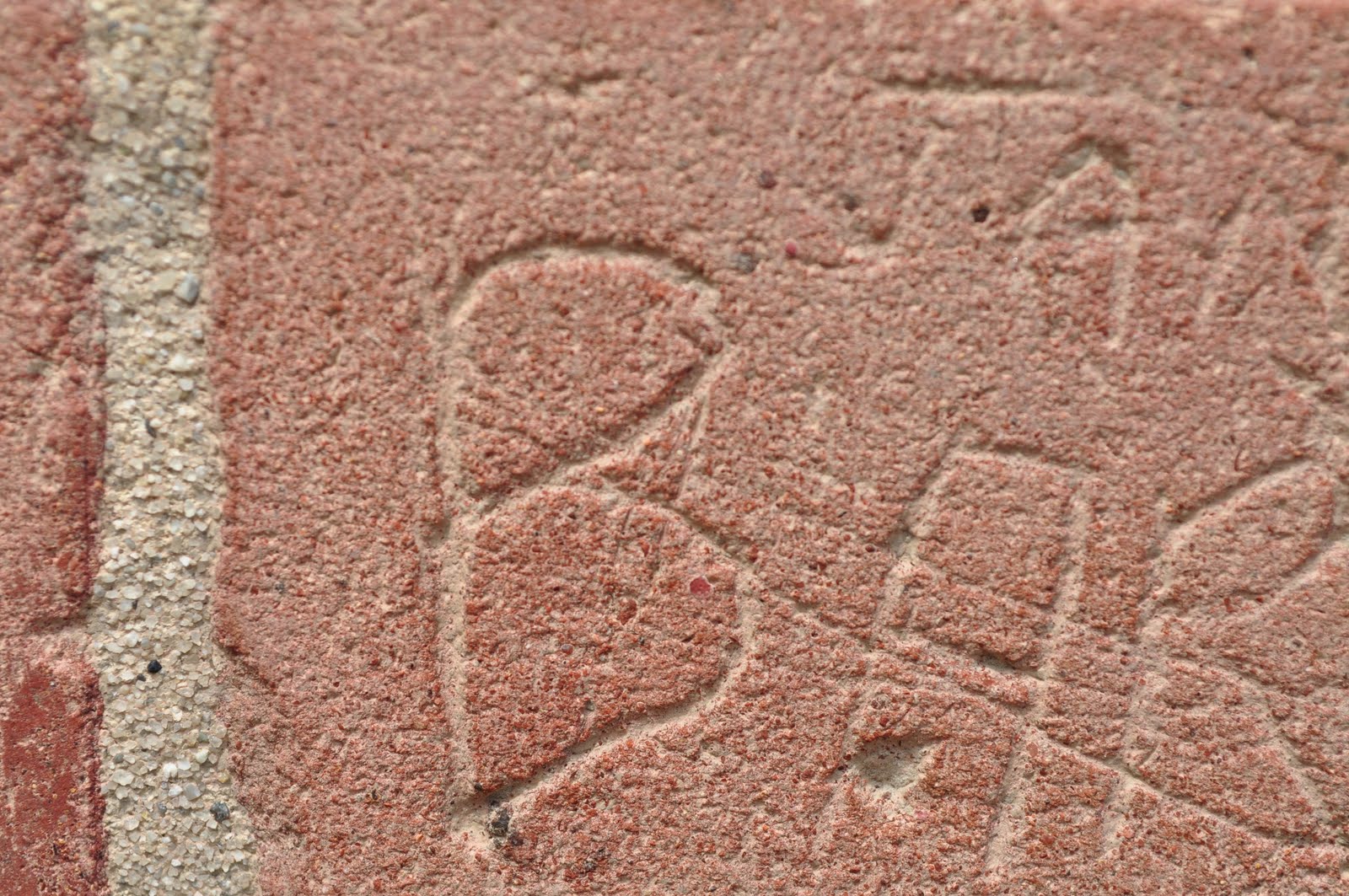
Then there was the image that's at the top of this post, and I felt things begin to shift. I remembered my interest in patterns and the edges of things.


I started thinking about what was going on with the patterns I was photographing, what made these photos more visually interesting to me than what I'd started out doing that day, and realized I had stumbled on some craft ideas that were applicable to writing:

Juxtaposition works as a way of showing how two disparate objects rub up against each other, the tension comes from the degree of difference between them. For example, black and white creates a much greater sense of contrast than two shades of blue. It's also a way of showing how two objects can be affected in radically different ways by the same process.


The same idea is true in fiction. How sentences, scenes, and chapters are ordered can create radically different effects because of what happens before it and after it. Juxtaposition of characters is also important. Nothing bothers me more in a story (especially TV shows or movies) when story lines are essentially the same - different characters going through the EXACT SAME THING. Shakespeare used subplots to echo the main plot line. There were similarities, yes, but he showed different outcomes through his subplots, the dynamics of each plot were different. Putting too many similar characters together makes a story very bland, although I also have a problem with a lot of contemporary fiction where characters are quirky for the sake of being quirky. So it's a delicate thing. But back to the photography because here was my visual art form showing me something I was forgetting in my novel - the juxtaposition of two characters in a scene.

I also noticed that what makes repetition interesting is when it's broken. It's the unexpected surprise that really makes us aware of the pattern.

And then there was the moment I found a small project, and really felt my inner artist kick in. Many of the bricks on the exterior of the fort have names carved into them, some of them dating back to the 1930's or earlier, so I created an alphabet by finding each sequential letter in the names on the fort's facade. It was a challenge, and I'm sure I looked quite deranged scanning the bricks and saying, "'X', there's an 'X,' I have to remember that." When it was done, and I had found all 26 letters, I felt great.


Which was another lesson for me to remember: if the big project isn't working, give yourself a small assignment. A scene, some dialogue between two characters, a scene written from another character's point of view.

And, ultimately, the big lesson of the day for me was about giving up the illusion of control in the creative process. I'd been trying to control my novel too tightly, and it was rebelling. I'm dealing with a pissed off fourteen-year old narrator, sometimes my novel takes on that personna, and I have to remember that when I'm dealing with it.

There is an adage that lots of writers like to repeat about discipline and the necessity of showing up every day. While I agree with that, I also believe it's more important to honor the way you want to write. For me, when I try to adhere to a strict, every day writing schedule, my writer shuts down. I have to let my writer guide me, trust that she knows what she's doing and, if she says she needs a break, to take that break even when it's frustrating or doesn't make sense. Thank goodness I have a second art form that makes it possible for me to be creative and figure things out while in the act of creation.

And the last thing I learned. When you're really stuck, steal someone else's artwork and make it your own:

Wednesday, April 6, 2011

What Do You Want?


Home-schooled teen and I finished our discussions about The Aeneid yesterday. I've talked about HST before - she's the youngest daughter of a friend of mine who decided that, after watching her two older children graduate from high school without a passion for learning (or basic knowledge of science, which is my friend's field), she was going to take matters into her own hands. I offered to take on HST's literature class, an offer that was met with a great deal of enthusiasm since it's not my friend's area of expertise. HST and I started out reading the Lord of the Rings trilogy, then went several thousand years back in time to Gilgamesh and The Odyssey, both of which I've talked about in previous posts for their surprisingly "modernist" story-telling as well as my unabashed passion for The Odyssey. HST decided we should move on to The Aeneid and has since requested that we read The Inferno next.

I must admit, when HST asked to read The Aeneid, I wasn't overjoyed. I'd somehow managed to not have read it for the entirety of my literary life including an integrated Western canon-based Lit/History/and Rhetoric program during my first semester in college. We read The Odyssey, The Inferno, The Oresteia, Utopia, Richard II, and Plutarch, Euripides, Suetonius, Machiavelli, and, of course, Virgil. I know this because a friend of mine and I created a literary journal for our program and made the cover out of a photocopy of the spines of all the books we read (or were supposed to have). Despite this, I somehow missed reading The Aeneid, although I remember our classroom discussions about the death of Dido very well.

So, HST and I embarked on Virgil's master epic, a literary work that is, without much argument, the single most influential work in all of Western literature. Although Dante is the best known example of Virgil's influence, Shakespeare also borrowed heavily from him (I'm reading Henry V right now as I tutor an AP English student, reading these two texts in tandem has made it very clear how much the Bard borrowed from The Aeneid - the motif of fire, the struggle of a leader coming to terms with the inner desires versus the public responsibilities, the promise of a foreign bride who, though the ultimate prize of a war, is nothing more than a pawn in the masculine game of nation-building), as did Tennyson and George Bernard Shaw (his Arms and the Man is a direct reference to Aeneas). Virgil's battle scenes are a model for Tolkien and have probably influenced filmmakers as well with their blow-by-blow action that freely floats from one face to the next (with some pretty gory deaths, like warrior who's head and neck is split in two by a sword) and then homes in on one particular glorious battle, like the one between Pallas and Turnus - action, action, action, and then close-up. Even Harry Potter ends with a battle scene like this between Harry and Voldemort - and I do not doubt JK Rowling knows her Aeneid - she makes references to it throughout the series including the brother/sister Death Eater duo Amycus and Allecto - Amycus was a poisoner in The Aeneid and Allecto is the fury Juno sends down to inflame the Latins to war against the Trojans).

Anyway, we embarked. We read. We discussed. And, yesterday, we concluded, which leads me to share these thoughts.

First, some history about The Aeneid for those of you reading this who may not be familiar with it. Virgil was commissioned by the emperor Augustus to write a national epic for Rome somewhere around 29 B.C.E. Virgil was already a well-respected poet, having published two previous collections of work that were both popular and well-received. In The Aeneid, Virgil created the foundational myth for the Roman Empire, a way to explain the empire's greatness as having been pre-ordained by the gods. The basic plot is that a prince of Troy, Aeneas, escapes from the burning embers of that doomed city with the remnants of the Trojan people. His destiny is to found a new Troy in Italy. His mother, Venus, tells him this. In fact, there's a wonderful scene when Aeneas is recounting the fall of Troy where Venus pulls back the veil that shields the gods from mortal eyes and shows her son the gods themselves, Neptune, Juno and Minerva, tearing apart the walls of the city with their bare hands. And don't forget, Venus herself was the cause of the Trojan war because she bribed Paris (Priam's son) with Helen, the most beautiful woman in the world, if he would chose Venus as the fairest of the goddesses (Paris got this honor because, at the wedding of Achilles' parents, Thetis (who was a sea nymph) and Pelleus, Eris (goddess of discord) rolls a golden apple into the midst of the banqueting gods declaring that the apple should go to the fairest of the goddesses. Juno, Venus, and Minerva jump on the apple and then ask Jupiter to decide. Faced with choosing between his wife, his war goddess daughter, and the goddess of love (who in Roman myth is also his daughter), he defers to a human, Paris, to make the choice). So Virgil shows how the entire Trojan War was just a set-up for the ultimate founding of Rome.

Aeneas travels with his refugee population, gets shipwrecked in Carthage, shacks up with the queen of Carthage (Dido) and then leaves her a year later when the gods send Mercury to remind him that Carthage isn't the city he's meant to found. He leaves, Dido commits suicide. Aeneas sails on, has a few more adventures, and then his father's ghost asks him to come for a visit in the underworld, which Aeneas, the dutiful son, does aided by the Cumaen Sybil. Anchises, Aeneas's father, reminds him, once again, of his future, showing Aeneas the future souls of Roman leaders who are waiting to be born including Cesar, Augustus, and the doomed Marcellus (he was Augustus' nephew and chosen successor who died very young - the story is, when Virgil first read The Aeneid to Augustus and his sister, Octavia, she fainted as he talked about the tragedy of her son's early death). Aeneas sails on, lands in Italy, presents himself to Latinus, king of the Latins, gets offered Latinus' daughter, Lavinia, who, whoops, was already engaged to Turnus. War breaks out between the Latins and the Trojans - Virgil essentially refights the Trojan War in order for the Trojans to finally be victorious, which they are. Aeneas kills Turnus, wins Lavinia, and the Latin and Trojan people are united under the leadership of Aeneas, but, because of a deal Jupiter works out with Juno so she'll stop delaying Aeneas' destiny to found the Roman people, the Latins get to keep their name, their language, etc, and the name of the Trojan people dies instead.

Structurally, Virgil modeled his epic after BOTH The Iliad and The Odyssey. Both of Homer's epics are 24 books, The Aeneid is 12. The first half of The Aeneid is modeled on The Odyssey, with Aeneas wandering while he searches for a new home, being "held" by a woman (with Juno's help), and visiting the underworld. Aeneas even visits some of the same places Odysseus (or Ulysses, as the Romans called him), actually rescuing a stranded Greek Odysseus left behind on the Cyclops' island. The second six books, with their focus on war, is modeled after The Iliad.

Most modern readers prefer the first six books - the tragic love story, the adventures, the glorious visit to the underworld (in and of itself, the best-known section of The Aeneid, and rightly so. It's magnificent. HST and I spent a couple of weeks on Book VI alone), and find the endless repetition of names and battle scenes in the second half both confusing and boring. And I definitely approached Book VII with trepidation, having detested The Iliad when I read it in high school. I have to say, I found the second half of The Aeneid glorious. Virgil's tone and words beat out a rhythm as relentless as a war drum. His passages that read like a soccer announcer calling a game as he lists the names of who slayed whom and are followed by the action coming to a halt as two worthy adversaries face each other, are stunning. A model of how to build tension and modulate pacing to create a heightened effect.

(as an aside here, while I was reading this section, I listened to a radio program about dehumanization - the way in which turning an "enemy" group into animals (like rats or cockroaches) or making them less-than-human makes it easier to kill another human being and allows the genocides and atrocities of our modern era to continue. It struck me that both the Greeks and the Romans found it an honor to face a strong enemy. They did not take death lightly - they recognized what it meant to take a life, even in war, and took no honor in killing the weak. Glory in war, making a name for oneself, was the goal of every warrior. Odysseus, adrift in the ocean after leaving Calypso, laments that he could not die on the battlefield so he could have died in a way worth remembering. In The Aeneid, the woman warrior, Camilla, is taunted that her death will not bring the glory that killing a male warrior would (this despite the notches on her war belt). The contrast between the modern need to make an enemy weak, to turn them into an animal, in order to kill them versus the ancient desire to face an enemy who was your equal and prove your strength, was profound to me.)

Ultimately, though, I have to say I am not enamored of The Aeneid. Virgil is a masterful writer. His imagery in Book VI is beautiful. His command of his subject and his ability to not only tell a good story, but also fulfill a much more didactic purpose, is extraordinary. But the epic leaves me cold, and I think I know why.

Aeneas is never at risk for losing what he desires.

In The Odyssey, by contrast, Odysseus' happy homecoming is ALWAYS in doubt. Not only does he have to survive a war, he also contends with homicidal monsters, a vengeful god, TWO goddesses that want to keep him as their boy toys, and a houseful of suitors who would like nothing more than for him to be killed in front of Penelope so she'll finally have proof her husband isn't coming home for dinner ever again. Even though we're pretty sure Odysseus will survive all his trials, Odysseus doesn't know it. The risk of his death, or the death of his son, at the hands of 120 suitors is real to him, so it becomes real to us, the reader.

In The Aeneid, we know Aeneas will succeed. Virgil has taken great pains to make sure we know Aeneas will succeed. The gods tell him his future over and over again. Venus and Mercury both tell him he needs to leave Troy and Carthage, respectively, because it is his destiny to found another city in Italy. Aeneas is shown the pageant of Roman heroes in the underworld. The river god, Tiber, tells Aeneas his son, Ascanius, will found another city, Alba, along his banks thirty years after the war is over. In Book 8, Aeneas goes to Pallanteum to ask for help from King Evander, and the king shows him his city, essentially giving him a tour of what will become Rome, pointing out a grove his people believe is favored by some god (this will be the future site of Jupiter's temple in Rome) and other places that will become famous Roman landmarks. In the same book, Venus has Vulcan create armor for Aeneas to wear including a shield which shows scenes from the Roman history (history to the readers/future for Aeneas) to come. Aeneas does not know what the scenes portray, but he knows he is hoisting his future as he raises his shield. And we, the readers, know it, too. The entire book is predicated on the conceit that Rome, and Roman supremacy, is inevitable. There is no tension. There is no fear that Ascanius will die like Pallas (as there was fear that Telemachus might be killed in the battle with the suitors) - he can't, he's going to found Alba and his descendant will be Romulus who will be the founder of Rome. There is no fear Aeneas won't succeed or will succumb to any inner desire on his part to do something contrary to his destiny. He won't. Even Juno eventually yields to the inevitability of Aeneas' fate. There simply is no risk, no danger, that Aeneas will lose the thing he desires.

It is this that makes The Aeneid, as technically brilliant as it is, ultimately unsatisfying for me. It's a lesson, too, as I move forward in my own novel, to remember how powerful the threat of a character NOT getting what they want is. It's the question I come back to again and again as I write drafts of query letters for Altar. What does Matt want? Up until this week, I kept answering that question by saying he wants his brother back. Which was unsatisfying. He can't have his brother back. His brother is dead. He knows he can't have his brother back. So I knew that wasn't the right answer.

Last night, in a workshop I'm taking from a really brilliant teacher (here's his website: http://www.matthewclarkdavison.com/), we talked about connecting and disconnecting, desire and the intensity of wanting something. Then, as usually happens when I take a class with Matthew, he gave us an exercise that was so perfectly attuned to the scene I'd been struggling with in my novel yesterday, it was as if he'd been sitting on my shoulder the whole time and said, "Hey, I've got exactly what you need." I got it. And I got what Matt (my character) wants more than anything. He wants connection. It's why Denny's death affects him so deeply - Denny was his connection to the world and, especially, to his family. It's why his girlfriend becomes so important to him (she's the first person he connects with in his entire life who wasn't part of his life when Denny was alive - she's his lifeline into a post-Denny world). And why, when he's standing in his mom's bedroom trying to do something for her and she keeps shutting him down, he is wounded. And there, in fifteen minutes of a writing exercise, was the answer to the essential question of my query, the lack of which has been preventing me from writing a satisfying query letter. What does Matt want? He wants connection. What keeps him from getting what he wants? He has to learn how to connect without Denny. (Okay, that's a little weak yet, but it's in the book, I just have to come up with a snappy, unique way of saying it).

I guess, in summing up, I want to say, this is why we read. Because the things we read can explain our own work (and our own minds - there are things I realized about myself and what, within myself, created this novel) to us, can lead us to think about what we are doing and how we are doing it. When I write about conflict, I can draw on this model of pacing from Virgil now. Bam, bam, bam, exhale.

So now, HST and I are taking a short break from the classics to read some short stories, and then we're going to hell with Virgil as our guide.

(P.S. I also want to give a shout-out to my friend, Traci Chee, who's putting up some really great posts from the other end of literary time at I'm Traci Chee and This is My Blog)

Sunday, March 13, 2011

In the Name of Love


A few years ago, when I finished reading the seventh Harry Potter book, my first thought, upon closing the cover of that magnificent book, was not about how the series had affected me, but to wonder what J. K. Rowling felt like now that she was done writing about Harry, Ron, Hermione, Snape, Dumbledore, and all the other remarkable characters with whom she had been living for the past fifteen years.

Writers have a much different experience of their characters than do readers. While I can appreciate the many layers of Snape's character and envy Rowling for creating a character like Dumbledore, I'm an observer only. It's much different on the inside.

Writers feel their characters. We hear them whisper to us, know what they long for, experience their sorrows on a deep, visceral level. They are like our children, but more than that. They live inside our bodies and minds, and we watch them develop and grow, become multi-layered, complex beings. Like children, they start out as single-cell organisms, simple. Something happens to them, they react. Then, we figure out why they reacted that way. They acquire history and a backstory. We write about their actions, what they look like. A simple change of hair color or the way a character stands, can reveal an entire strata of meaning we didn't know about before. And that moment of understanding, of looking into the character's eyes and figuring out just what this person (because that is what they come to feel like after awhile) has been trying to tell us, feels like falling in love.

The relationship is far from one way, either. Because our characters seem to know they need us to tell their stories, they come to us willingly. They want us to know things about them. Many, many years ago while I was working on another novel, I was having trouble with the female protagonist. I couldn't get her exactly right. I wasn't understanding what would cause her to act the way she was in the story (yes, I was creating the story, but, sometimes, in the act of writing, things flow onto the page you didn't expect, and then you've got to figure out what to do with them). So I set up a meeting. I was freelancing a lot during this time and doing one or two interviews a day, so I decided to interview her.

We met for tea in my office. If I remember correctly, I actually did set up a tea cup for her opposite my own. Then I sat down and started asking questions in my notebook and writing her answers as they came to me. "Why do you keep pushing Peter away?" "What did his drawing mean to you?" "How do you feel about the time you saw each other in New York?" As I did this, I heard her voice in my head, more clearly than what I'd been hearing while I was writing the novel (which was told primarily from the male protagonist's point of view), and I started to get a picture of her in my mind as she sat across the table from me. And then, I realized, she was holding her right hand in her left and massaging the back of her hand. It was a stress reaction, something she did when she was uncomfortable. So I asked, "What's going on with your hand?" And she told me. Her mother was an alcoholic who had thrown a copy of Gray's Anatomy (her father was a doctor) at her during a drunken rage (she'd been sent home from private boarding school because alcohol had been found in her dorm room, left there by a roommate who had moved out). She'd put her hand up to protect herself but the force of the book falling against her hand had broken it. Furthermore, she wouldn't let her mother touch it, but waited several hours until her father came home so he could take care of it. Several hours in excruciating pain. This told me a lot about why she'd been so reluctant to speak to me before this, why she was such a difficult character to get to know. She didn't trust people easily. But it also told me, this woman could be incredibly resilient, incredibly strong-willed. It told me, in short, the things I needed to know to be able to write her effectively and compellingly.

I write this because, in the chronology I've worked out for Altar, this is the weekend Denny dies. March 12. The funeral is the 16th. All this past week, I kept thinking I needed to get candles to light for Denny. While it made sense in a certain way, it wasn't something I'd felt such a strong need to do in previous years. Then it hit me. This is the last year I'm going to be with Matt and Denny. The book is almost finished. And, even though I'll most assuredly be doing revisions if it sells, I won't be creating these characters in the same way ever again. These are our last days together in such intimate company. While I feel as sense of joy and accomplishment at that, there is still a measure of sorrow that these characters will no longer be my constant companions. I'll be moving on to a new set of characters, falling in love with them in the way I have fallen in love with Matt and Denny and Alan and Rachelle and all of them.

So I have two candles on my desk, one for Matt and one for Denny, and I light them when I start writing and blow them out when I'm done. Nothing magical has happened because I've done this, it's just enough that it's been done.

Writers sometimes talk about a mourning period after a book is finished. They talk about needing a period of not writing to give the previous book some honored space, or of not being able to move forward right away with the next project no matter how hard they try. Which is why, after the seventh HP book was released, I read interviews with Rowling with increasing disappointment, and would have loved to have interviewed her myself. I would have asked her how it felt to no longer be in such close contact with her characters, if they still came to her with lines of dialogue or thoughts about the action, and if she worried about being able to fall in love with a new set of characters as deeply as she had with these. Because, it was clear from her writing that she loved each and every one of them, and understood that if you don't love your characters, no one else will.