Showing posts with label writing. Show all posts

Wednesday, July 8, 2020

Is It Done Yet? Part 4 – What the Story Needs


This is the fourth installment aimed at helping writers know when their novel is ready to query. It's based on the presentation I made at the Las Vegas Writers Conference in April of this year, "Is It Done Yet? How to Know When Your Novel is Ready to Query"

Part 4 – Stages of Revision

What the Story Needs

In Part 3, I talked about the first stage of revision, Telling (Yourself) the Story. Essentially, a Stage 1 manuscript is driven by what the writer needs to know or discovers about their characters, plot, story, etc. There’s often a good-sized chunk of backstory or core dump of research. A Stage 1 manuscript sometimes withholds crucial information until the end of the novel, which leaves the reader guessing about character motivation or being bewildered about the situation a character is in.

In the previous post, I explained that this often happens because the writer has completed that first draft and moved on to editing without taking the time to understand the story they’re telling. They assume that the backstory they needed to write is an essential element of the story or that the withheld information builds suspense. Sometimes it does, but most of the time those elements need to be more fully digested and integrated into the story for the novel to move forward in a dynamic way.

This is why the next steps are an important part of the revision process. Stage 2, Telling the Story, and Stage 3, Telling the Real Story, are driven by the needs of the story. These stages ask you to take a look at what you put on the page at both the macro and micro level and turn all the subconscious choice you made while writing into conscious choices that work in service to the larger story.

In order to do that, there are two things you need to do before you begin revising:

Read your draft – Just read it as quickly as you can without making any changes. No matter how painful this is (and it is sometimes VERY painful), it’s important for you to get a sense of the draft as a whole.

Reading the draft is important because it’s difficult to get a good feel for the rhythm of your novel while you’re writing it because some scenes take forever to write but are very quick to read, while other scenes that go on for pages may only take us a few hours to write.

You also catch things like continuity errors (Did you change the name of a character halfway through the novel? Change a detail in the character’s history? Leave a subplot unresolved because you realized it wasn’t working?) and repetitions of ideas, phrases, imagery, etc. Take notes if it makes you feel more comfortable, but don’t get bogged down in revising just yet.

If it’s distracting to do this on either your computer or hard copy, I recommend emailing your manuscript to your Kindle reader. It will show up, formatted as a book, in your library (you can find the email address for your device on the Amazon homepage – scroll to the bottom and click on “Manage Your Content and Devices”).

Create a timeline – this isn’t just a scene-by-scene outline of your novel (another tool that’s useful if you’re feeling ambitious), but a timeline of your story with indications of scenes that are in the present storytelling moment (á), scenes that are backstory or flashbacks (â), or digressions (à).

This exercise does two things. 1) it helps you see the novel more objectively because you’re not reading it as much as processing the information, and 2) it gives you a visual of how often the forward movement of the novel is suspended, breaking what John Gardner called “the continuous dream of the novel.”

This is why I make such a big deal about backstory. Every time you interrupt the present storytelling moment and break the forward flow of the action, the reader has to do a mental recalibration to locate your characters within the story (How old are they? Where are they living? What was the last thing that happened to them?). And every time the reader leaves the dreamlike state and goes into their head, you give the real world a chance to intrude – What do I have to do today? What time is it? – and risk the reader putting down your book, possibly never to return.

So now you’re armed with some important information about your draft. You’ve got a sense of what is and isn’t working, as well as a sense of what’s essential to the story and what you needed to write in order to tell it. Now it’s time to turn to…

Stage 2: Telling the Story

One of the biggest mistakes I think writers make is believing that everything they wrote during a Stage 1 draft is important to their story. It is very important and necessary to the writer because it’s the way we discover the story we’re really telling. But it’s not necessarily important to the actual story or to the reader.

Stage 2 is about fully assimilating the hallmarks of the story’s creation and making active, conscious choices about how the story is being told. Revision here is focused on the questions of what it is:
·       the novel’s structure (is it linear or modular; chronological or asynchronous)
·       the novel’s market – literary (language driven), upmarket (character driven), or commercial (plot driven)
·       its genre and the genre’s conventions (does it conform to reader expectations or subvert them?)
·       pacing (does the novel hit the right turn or complication at the right time for its market?)
·       POV (single, multiple, 1st, 3rd? Does that choice give you the best vantage point from which to tell the story?)
·       descriptions/details/setting (do they work in harmony or do they feel “off”)
·       what questions does your novel explore and do the choices you’ve made work in service to them?
·       information flow (what gets revealed when)

Of these, the last one is where the timeline comes in. If you see a lot of breaks from the present storytelling moment, take a look at the backstory or flashback moments and decide what the most relevant pieces of information are. Is there a way to convey this information in the present moment of the story through character action or reaction? In the details of a scene or the setting?

In my work as an editor, I most often see writers using backstory within the first fifty pages as a way to give the reader information about their character or the situation the writer thinks they need to know. In real life, this isn’t how we get to know people or understand the world. There isn’t a narrator to sit us down and give us someone’s entire history, so we’ve become very good at discovering patterns of behavior and learning in the moment. The same is true when we want readers to get to know our characters and the world in which they live. Finding ways to integrate the important information is more natural to the way people learn and discover.

Another thing to pay attention to as you revise is what I call “real estate vs payoff.” How much space are you giving in your novel to minute pieces of information? One of the first books I edited back when I was working for a literary agent, was a mystery that took 65 pages to set up the very first clue. Usually, that first clue in a mystery is pretty low stakes, the more important pieces of information will come later as the plot becomes more complicated and the situation more dire. I suggested summarizing most of the original setup, streamlining the scene where the information is revealed so only the most relevant parts of the conversation were rendered in dialogue, and simplifying what leads the main character to this moment in the first place. The result rebalanced the pacing of the novel, so this first clue took up space (real estate) was more in line with how important (payoff) it was to the overall story.

The same is true no matter what genre you write. A literary novel I worked on recently took roughly 5% of the entire novel to explain a small detail of how the world of this novel functions. By integrating that facet into the way characters interact from the very first page, the explanation wasn’t necessary. This, again, is a part of paying attention to the difference between what you (the writer) need to write to create the world and what the reader needs to see or know to understand it.

The main thing to keep in mind when working on this revision is paying attention to what’s truly essential to the story and what isn't. 

Up next: Stage 3 – Telling the Real Story (I’ll try to make it a shorter blog post, but I’m not promising anything).


If you’d like to receive a copy of my revision flow chart, please contact me at: diane.glaz@gmail.com

If you'd like more information about my editing services, please visit my website or contact me through email, Facebook, Twitter, or IG. I specialize in literary, upmarket, commercial, YA, contemporary women's, erotica, and fantasy, and have a diverse and international client base whose work has appeared on the NY Times best seller lists and Amazon top seller lists.

Twitter: @DeeGeeWriter
IG: diane.glaz
(If you follow me on IG, be forewarned: you'll see a lot of pictures of my Airedales and whisky)

Here are the links for the all the parts of this series: 

Part 1: The goal of a fully-realized novel

Part 2: Know your genre

Part 3: What the writer needs - Telling yourself the story

Part 4: What the story needs - Telling the story

Part 5: What the story (also) needs - Telling the real story

Part 6: Destabilizing and inciting incidents

Part 7: What the reader needs

Wednesday, May 13, 2020

Is It Done Yet? - Part 1


This is the first in a series of posts I’m doing based on a presentation I made at the Las Vegas Writers Conference in May of this year focused on how to know when your manuscript is ready to query. 

Part 1 – The Goal: A Fully-Realized Novel


Knowing when your manuscript is ready is a topic that comes up quite regularly in many writers’ groups both online and off. Most of the time, the usual advice gets offered: it’s done when you can’t stand working on it anymore; it’s done when all you can revise is punctuation; it’s done when you think it is; it’s done when your beta readers tell you it is; it’s done when you’ve done x number of revisions; it’s done when you don’t know what else to do with it.

All of these responses miss the mark because the question being asked is: when is my novel ready to query? Underneath that question is the real one: how do I know my novel will attract interest from an agent?

My answer, based on my work as a developmental/ content editor, and several years reading and editing submissions for a literary agent, is a bit more complex and based on both the writer’s understanding of their work and the demands of the publishing marketplace.

Reading for the literary agent taught me a lot. Mostly, it taught me that the vast majority of manuscripts being queried weren’t ready yet. They needed at least another revision to become what I call a fully realized novel.

A fully realized novel is one in which all the novel’s elements work together to create the dynamic forward movement that propels the characters (and the reader) from the first word to the last in a satisfying and unified manner. There is a clear and well-defined premise or central question that organizes the plot, characters, theme, setting, relevant details, structure, information flow, and sequence of scenes. In a fully realized novel, everything that is on the page is relevant and necessary to create the overall effect of the work. The overall effect of the novel is vastly greater than the sum of the individual parts. 

A movie I think does a near-perfect job demonstrating what fully realized storytelling looks like (and I’m using a movie here because they create a complete story arc in roughly two hours) is EverAfter, the Drew Barrymore and Angelica Houston retelling of Cinderella.

What I love about this movie is that nearly everything, from the costuming to set design to dialogue has an arc with a purpose and a payoff.

For example, the line, “You have been born to wealth and privilege and with that comes specific obligations” is spoken three times. First by the Queen of France and then Danielle (the Cinderella character) to Prince Henry, and lastly by the Prince himself. Each time, the line changes in meaning and it effectively shows Henry’s growth from the errant prince attempting to shirk his responsibilities, to realizing the opportunities his position might afford for helping others, to a belligerent response after Danielle’s identity as a commoner is revealed at the ball and embarrasses the prince in front of his subjects and father (in response to which, Leonardo DaVinci, this movie’s fairy godmother, says, “Hogwash” and tells the prince to get over himself; if that's truly what he believes, he doesn't deserve Danielle).

Similarly, a distinctive ruby and pearl necklace provides a subtle detail that has significant payoff. One of the royal pages took the necklace from the queen’s bedroom and gives it to the stepmother so that a meeting can be engineered for the older daughter, Marguerite, and the queen. After church, Marguerite “returns” the necklace to the queen saying it must have fallen off while she was inside. The queen rewards Marguerite’s honesty by inviting mother and daughter to the palace for a chat. At the end of the movie, when Danielle is presented to her family as the prince’s wife, she’s wearing that necklace. No mention is made of it, but the arc of that small detail is clear. In addition, there’s an earlier scene in which the baroness is buying a broach with the intention that Marguerite wear it to attract the prince’s attention. She keeps telling the seller that it needs to be bigger, to which he says, “I fear if it were any larger, she might tip over.” These are two instances where the details that are called specifically to the viewer’s attention have significance and meaning.

A fully realized novel provides the same sense of purpose, arc, and payoff for all its elements. Every scene carries a sense of the underlying premise or question, every detail relates to it, every plot point builds toward the payoff. 

A great test for whether the novel is fully realized is how easily you can write your query letter or create an elevator pitch for your novel. I think many writers struggle with their queries because their stories haven’t coalesced around a central focus that drives the narrative forward, and this is mainly a result of not pushing past the initial stages of revision to the place where the story, that connective tissue that creates relevance and unifies the narrative, emerges and becomes clear.

In Part 2, I talk about knowing your genre as an important first step in the revision process. 


If you’d like to receive a copy of my revision flow chart, please contact me at: diane.glaz@gmail.com

If you'd like more information about my editing services, please visit my website or contact me through email, Facebook, Twitter, or IG. I specialize in literary, upmarket, commercial, YA, contemporary women's, erotica, and fantasy, and have a diverse and international client base whose work has appeared on the NY Times best seller lists and Amazon top seller lists.

Twitter: @DeeGeeWriter
IG: diane.glaz


(If you follow me on IG, be forewarned: you'll see a lot of pictures of my Airedales and whisky)

Here are the links for the all the parts of this series: 

Part 1: The goal of a fully-realized novel

Part 2: Know your genre

Part 3: What the writer needs - Telling yourself the story

Part 4: What the story needs - Telling the story

Part 5: What the story (also) needs - Telling the real story

Part 6: Destabilizing and inciting incidents

Part 7: What the reader needs


Monday, August 6, 2018

The Story Thus Far...

My last post was my Pitch Wars bio, which I posted almost exactly two years ago. Some of you may remember that I'd completed a novel revision at the behest of one of my dream agents. We'd met at a writer's conference, he was very enthusiastic about me and my novel, and he coached me through the revision for three years loving everything until I turned in the completed revision, at which point he said no to taking me on as a client. Which was fine. Agents are allowed to change their minds. Their lists and needs change. Something else new and shiny comes along that is a better fit. Doesn't mean it didn't hurt and I didn't care. It  meant there was more work that needed to be done on the novel.

So I looked at Pitch Wars, which is a fabulous program in which you apply for a mentor and, fingers crossed, get picked by your mentor for a couple months work on polishing your novel and your query before you get to try it out for agents during the Twitter pitch-fest called Pitch Madness. I didn't end up with an official mentor for Pitch Wars, but my number one pick offered to unofficially mentor me. Unfortunately, I wasn't really in a place where I could take advantage of having a mentor. I didn't realize how much I was still reeling from the agent's rejection (TBH, I actually didn't realize it until last month) and how much anger I was suppressing because I was trying to be very professional about the whole thing and just move on. Having Jenny offer to be my unofficial mentor was probably the best thing that could have happened at that moment, though because it meant my novel was good enough to get someone to champion it. That meant everything at that moment, and Jenny has become a good friend and AMAZING cheerleader for everything that has happened in the past two years since we met.

But the novel just sat there. I fiddled with ideas, created mountains of notes on things I thought was wrong with it, broke it down into individual beats (which resulted in an enormous document over 500 pages long), read craft books, and gradually watched the steam go out of any writing practice I might have had. I tried to work on another novel. I tried to work on short stories. Eventually, though, I stopped writing completely.

This isn't to say I wasn't doing writing-related things. I read voraciously (more on that in another blog post). I started editing professionally (also more on that in another blog post). And I started doing some freelance writing again (another future blog post).

My writing retreat partner/bat shit crazy twin and I continued to go away for retreats and even got ourselves a two-week residency in Bend, OR, in November 2017. One of the best things about that writing retreat was visiting a friend who lives in Hood River, OR, and who is my artistic mentor. She's about a decade older than I am and a professional photographer (she's the one who does my headshots) who recently closed her studio business in order to return to her art. In between visits to Columbia River Gorge wineries, we talked about art, writing, photography, and getting back on track. I came home from Bend with copious notes of what I wanted to do with the novel as well as an invitation to read at two SF reading series, Shipwreck and Literary Speakeasy. The reading for Shipwreck meant that I actually had to write something new based on a character from Dickens' A Tale of Two Cities. It was the first new writing I'd done in almost a year and a half, and it was, by far, the most fun I had writing anything EVER. I loved the characters I created so much, I started planning out a novel for them.

But the big novel, the one I'd been working on for years, the one I'd worked on during my MFA program, was still languishing. I simply didn't know what to do with it.

Enter my friend, Sheena, who contacted me and asked if I could write her a letter of recommendation for a year-long novel finishing program run out of SUNY-Stony Brook by Meg Wolitzer and Susan Merrell. Of course I said yes, and then I looked at the program. And then I asked Sheena if she would be upset if I applied for the program, too, because it looked like exactly what I needed. I told her, if it wasn't okay, I would be fine waiting until 2019 to apply because her friendship meant more to me than the program, but she generously told me it would be fine. Fortunately, we both got accepted to BookEnds. Go us!


The program started in mid-July at the Southampton Writers' Conference, but I knew I needed to get my head back into my novel and start applying all the things I'd thought about doing to it over the past two years. So I packed up the dogs and myself and headed for a friend's cabin in Oroville where I toasted each sunset, and spent the days reading my novel.


I also had an assignment from BookEnds: choose the ten weakest pages of my manuscript and write a 1-2 pages summary of why I thought that way. I was pleasantly surprised to find there weren't as many candidates for "weakest section" as I'd feared, though I did come back from my week in Oroville feeling like the entire novel was horrible, overwritten, and didn't even come close to doing what I wanted it to do. Still, I got the novel read, got some work done on the other "fun" project, got some work done for editing clients, and got some reading done. Basically, I started behaving like a writer again, which was good because....


A week after I got home from Oroville, I boarded an airplane and flew to New York for the Southampton Writers' Conference and the start of the BookEnds program.

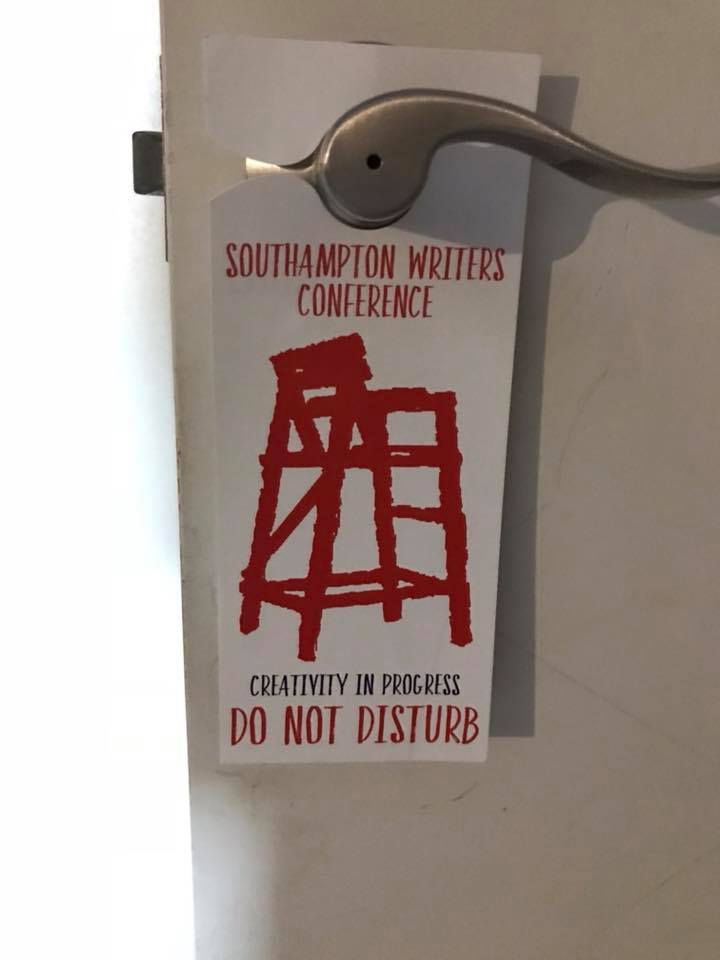
Twelve days of living in a dorm room tiny enough that the door couldn't be opened fully without banging into the dresser. Twelve days surrounded by other writers. Twelve days of panels and readings and talking about books. And twelve days of getting to know Meg Wolizter and Susie Merrell and the other eight BookEnders. It was not all peaches and cream and sweetness and light. It was a lot of hard work, stress, anxiety, and, ultimately, a breakthrough on how to get my novel to where I want it to be, plus the development of an incredible support network who will be there for me over the next year. Deadlines, accountability, phenomenal writers, and a commitment to advocate and assist and support each other in achieving the novels we want. Yes, please!

Talk about feeling like a writer again!

After the conference was over, I got to decompress at a friend's house and spent a phenomenal day in Manhattan at the Guggenheim where I reveled in the Giacometti exhibit.

I found myself fascinated with the space the artwork occupies as well as the space that surrounds it, and how my presence interacted with the artwork, hiding some facets while revealing others as I moved around the piece. It was, in visual form, a representation of everything I had been thinking about my novel and helped settle those revelations and insights deeper in my brain.

Then, I got on an airplane and came back home ready to get back to work on my novel.

So, over the next year, I plan on sharing insights on how revision happens, how it stumbles, where I completely go off the rails, successes and failures, and what the BookEnds program is like. I also hope, along the way, to give insight into what the writing life looks like and how one writer's process moves forward.


Seriously the best piece
of conference swag EVER.
Watch out, world, the Word Slut has returned.


Saturday, July 16, 2016

#PitchWars Bio

Welcome to my #PitchWars bio. 

Interesting Facts About Me:

photo credit: Elizabeth A. Caroli
1. I am a volunteer with the National Park Service’s Mounted Patrol in the Marin Headlands. I’m going to be featured in a national magazine this fall as part of an article on the physical and mental health benefits of volunteering (And, yes, that horse is sticking his tongue out at the camera, he's a bit of a clown).

2.  I started riding when I was in fifth grade and competed on my college’s equestrian team, which sounds a LOT more snooty than it was. We were an intercollegiate team (IHSA) and, though we competed against schools like Skidmore and St. Lawrence where most of the riders brought their own horses to school with them, I went to a SUNY school and we “trained” at a local stable where the horses were one step up from trail horses.

3. I spent a large part of my childhood at dog shows and put obedience titles on three dogs before I turned 18. My mom showed conformation, and my dad was an obedience judge and dog trainer. I still have dogs (two Airedales at present), but haven’t been to a dog show since I went to college (and, no, it isn’t like the movie Best in Show).

4.  I sometimes seem to wake up in possession of Neil Gaiman’s hair. I suspect he might like it back at some point. 

5. I worked as a freelance writer for many years and wrote on a variety of topics including finance, travel, health, Harley-Davidson motorcycles, Holocaust survivors, and the Yucca Mountain Nuclear Waste Repository.

6. I am always looking for the perfect tiramisu.
photo credit:
Denise Rehse Watson

7. I am a whisky-drinking woman and proud of it. I favor heavily-peated Islay single malts and love when guys try to help me pick "something for my husband" in the whisky aisle. It usually ends with them asking me to recommend what they should drink next. If you follow me on Twitter (@DeeGeeWriter), half my tweets are about whisky (the other half are about writing). 

8. My favorite book is The Odyssey. I reread it every couple of years and never fail to find something new about it. The Hitchhiker's Guide to the Galaxy is a close second.

9. My favorite writers are Virginia Woolf, Toni Morrison, and George R.R. Martin (and, before you ask, I am a die-hard geeky fan-grrl book-first fan for Game of Thrones. I’ve even read the Dunk and Egg novellas).

10. My favorite place in the world is the Shetland Islands. One of my goals is to do a 4-to-6 month writing residency in the Shetlands within the next five years.


About Me:
Complete Writer’s Bio:

photo credit: Denise Rehse Watson
I was a storyteller even before I learned how to form letters, narrating my toys and model horses through adventure after adventure in my Barbie Dreamcamper. I wrote my first short story when I was six, and my first novel when I was thirteen. It was a Star Wars novel, Children of the Force, written before fanfict became a thing, and it featured a disgraced female Jedi knight who fights the climactic lightsaber duel with Darth Vader and wins.

Though I didn’t realize it at the time, writing this novel was the only way I could be a part of a universe that I loved. A geek to the core, I’d started devouring my dad’s classic SF collection when I was twelve, but there wasn’t a place for me in those worlds. I wasn’t a princess to be rescued, or an innocent ingénue waiting for love, or a statuesque object for desire. I was a wizard, a shapeshifter, a warrior. And so I wrote to create a place I could inhabit and have value.

By the time I was sixteen, I’d completed two full drafts of that novel and knew I wanted to be a writer (I still have the original handwritten draft, by the way).

I studied creative writing at SUNY-Binghamton, left with a BA, and tried to be a good, responsible adult by getting a job in marketing. After seven years, I left corporate life to go it alone as a freelance writer. I wrote magazine articles, marketing communications materials, and ghosted articles for business executives. I was also writing fiction, had a few short stories published, received grants from the Nevada Arts Council and the Sierra Arts Foundation, and began work on a novel.

In 2001, my family and I moved to the San Francisco Bay Area, and I started teaching creative writing in the elementary and middle schools in our town. It was that work that prompted me to return to school and get my MFA in fiction from San Francisco State University. I graduated in 2010. I’m an alumna of the Squaw Valley Community of Writers and LitCamp, and am active in the Bay Area literary community.

At present, I am an associate editor for Zoetic Press, a small press that produces the NonBinary Review as well as independent titles. I also work with a Bay Area literary agent as her submissions reader and manuscript editor as well as working as a freelance developmental editor (small brag: two of the books I’ve worked on were released in 2016 by major publishers).


My project:

What You’ll Know Tomorrow is a literary/upmarket novel that explores issues of memory, history, race, and identity. It is set in Reno, Nevada. 

Quick pitch: After the death of his brother, Matt's quest for the truth reveals secrets about his family and the limits of his photographic memory.

Summary: For seventeen years, Matt Marshall believed in the infallibility of two things: his older brother and his photographic memory. Then one night of joyriding takes both away. Matt wakes with damp clothes and no memory of what happened. As he tries to put the pieces together, what he uncovers destroys what he knows about his family, himself, and the brother who protected him from their abusive alcoholic father. Matt discovers that not only was he complicit in the abuse his brother suffered, he is also responsible for his brother’s death, and these revelations fuel a desire to find the truth so great he will risk going to jail to discover it.


Ways to follow me:


Thursday, July 14, 2016

Slush Pile Reader -- Let Us Begin

Taking off my writer hat for a moment and putting on the one I wear as a slush pile reader for a literary agent, I want to talk about beginnings. At this point, I've been reading submissions for about two years and have looked at about 1,100 query letters and opening pages as well as read a significant number of full manuscripts. It means I've seen a lot of openings that just don't work, and I want to share with you some of the common pitfalls I see in the slush pile.

First, though, I want to talk about what an opening should do.

A novel's opening pages are how you introduce the reader to the world of the novel -- its characters, setting, conflicts, premise, themes, hopefully even the imagery and voice. These elements are the vocabulary you are going to use to tell your story and you need to have them on the page from the first word. In addition, the opening pages should capture some essential moment in the narrative arc, the moment when things are poised on the brink of explosion, a moment beyond which things are never going to be the same again. There should be tension and something should definitely be at stake even if it is not the grand stakes for which the characters are playing, something needs to matter in the opening pages.

While I've heard a lot of writers complain that contemporary publishing favors the quick start, the high stakes, flash and fire over substance, the fact is you can look at almost any classic work and see the same elements. Even Tolstoy, who is not the most succinct of writers, gets a heck of a lot of information into the opening paragraph of Anna Karenina:

ALL happy families resemble one another; every unhappy family is unhappy in its own way.

All was confusion in the house of the Oblonskys. The wife had discovered that her husband was having an intrigue with a French governess who had been in their employ, and she declared that she could not live in the same house with him. This condition of things had lasted now three days, and was causing deep discomfort, not only to the husband and wife, but also to all the members of the family and the domestics. All the members of the family and the domestics felt that there was no sense in their living together, and that in any hotel people meeting casually had more mutual interests than they, the members of the family and the domestics of the house of Oblonsky. The wife did not come out of her own rooms; the husband had not been at home for two days. The children were running over the whole house as if they were crazy ; the English maid was angry with the housekeeper and wrote to a friend begging her to find her a new place. The head cook had departed the evening before just at dinner-time; the kitchen-maid and the coachman demanded their wages.

The novel opens at a moment of high tension and discord brought about by the discovery of a husband's affair. It affects not only the married couple, the Oblonskys, but the family and their servants, and is so explosive that household staff are seeking employment elsewhere. And look at the movement of the narrative -- Tolstoy begins with a grand, sweeping statement of his entire book's premise. Then he immediately brings it to the family level, "All was confusion in the house of the Oblonskys...The wife did not come out of her own rooms; the husband had not been at home for two days." A quick summation of the current state of affairs that reveals the stakes (the future of the household) and is specific to this family and how the situation is affecting the individuals -- not only the upper class Oblonskys, but their children and their servants - the English maid, the housekeeper, the head cook, the coachman. The scope of this novel is global -- here, in the opening paragraph, Tolstoy is giving the reader notice of his intentions.

In the paragraph that follows this one, Tolstoy focuses on Oblonsky and, bam, we're in the story, and the looming conflict because Oblonsky is looking forward to the arrival of his sister, Anna Karenina, who will set all things to right in his household because Anna is dependable and steady and always knows what to do. Given the opening line of the novel, the reader should have a pretty good clue that Anna's arrival is not going to make things better.

So what are some of the common problems I see in the slush pile?

1. Starting in the wrong place -- it seems like it should be pretty easy to figure out where to start the story. It starts at the beginning, right? Not necessarily. There's a difference between where the novel starts and where the story starts. If you look at the opening paragraph from Anna Karenina, you'll see that the story starts three days before the novel, at the point where Countess Oblonsky discovers her husband's affair and locks herself in her room. Many writers would start with the fight (it's dramatic, right?) and use that fight to give a great deal of backstory about this couple (more on backstory in a moment), but the problem is the fight is not where things are about to change. And that's what's at the crux of a dynamic opening: the situation is dire, the stakes are high, and something is about to change.

2. Flashbacks and core dumps of backstory -- you would not believe the number of submissions I see where the writer gives a sentence, maybe a paragraph, of story and immediately goes into flashback or a core dump of backstory.

What this looks like:
Janet stood by the window of her corner office and stared at the people on the street below, so tiny they looked like ants. It had been a long hard fight to the top for her, starting in the mail room fresh out of college, studying for her MBA on the subway from Queens when she was living in a fifth floor walk up with no heat and five roommates (not counting the cockroaches)....etc etc etc

Why this doesn't work: it stops the forward momentum of the story dead in its tracks. In fact, there is no forward momentum to the story for the simple reason that no story has started. In simplest terms, story can be defined as a person in a place with a problem. While we've got Janet in an office, there's no problem, there's not even a situation. Think of the novel like a car trip. You get everyone in the car, turn on the engine, back out of the garage, and someone says, "I have to go to the bathroom." So you put the car in park, turn off the engine, and wait.

In a lot of cases, I think this happens because the writer hasn't found a way to fully integrate what he or she knows about the character yet.

So let's put Janet back in that corner office. She's standing by the window, staring at the street where the corporate limo is waiting to take her to the airport for the most important client meeting of her life, and she's picking at her carefully manicured nails, frustrated because she's just ruined a $200 manicure, a month's rent on her first apartment out of school, she notes dryly. She tugs at the her suit and tries to square her shoulders in it, but she can't get it to settle quite right, wishes she could imitate the ease with which her colleagues inhabit their Brooks Brothers and Brionis and Armanis. And in walks Arthur, the CEO, who plops a folder onto her desk and says, "I've decided to give the account to Allison. You're going to be working on the Podunk account."

And then you don't stop to add in all the stuff about Janet's night school MBA and the 5th floor walk up, you go on with how she copes with this change in plans and how all that other stuff informs her reactions to what has happened.

3. Withholding information -- it seems like holding something back from the reader would build suspense. The strange thing is it rarely does. I think this is because tension comes from the reactions of the characters to the thing, how they cope with it, what it does to them, not the thing itself. When you name the thing that has happened at the beginning, you create the space for the character to react, and you give the reader the satisfaction of knowing why the character is doing what he or she is doing. Another reason why this does not produce a dynamic opening is....

4. No stakes -- stakes are about risk, about what's on the line for your character if she does or does not do something. Stakes don't have to be life or death, but they do have to be important to your character. For example, while getting a bad grade on a test seems pretty low stakes, what happens if this grade is the difference between the character being able to play in a particular football game, which could be the difference between receiving a scholarship and going to college or ending up working in a fast food restaurant. And what if the character is trying to do the right thing and study hard, his friends convince him to go out and party the night before the test or, even better, give him the answers to the test so he faces a moral dilemma. Study on his own and possibly fail and ruin his life OR cheat and virtually guarantee his success.

While the stakes don't have to be sky high in the opening pages of your novel, something has to be at risk. In Anna Karenina, the household is falling apart. It's been three days, the children are running amok, the household staff is leaving, and the parents still aren't talking.

5. Cattle call of character introductions -- You need to get a story going, and stories need characters. One of the most delicate things a writer has to do is let the reader know which characters are important to the story, which characters they need to pay attention to, and who's expendable. One of the ways a writer does this is by how characters are introduced. Generally, more important characters are given more detailed introductions. We find out more about them, get a move vivid description of them, have lines of dialogue or interactions with other characters so we learn who they are. When you give readers an entire room full of characters, it's a little like being at a party where everyone goes around the room and tells you their name. Hi, I'm Alice. Jim. Samantha. Rupert. Stephen. Bob. Helen. And two seconds after you shake hands, you have no idea who you're talking to.

This doesn't mean you have to take things slowly. If you're opening scene is a party, by all means, make sure there's a roomful of people. Just make sure you introduce me to the ones it's important for me to know in a way that tells me this.


I think the most important thing to remember about your novel's opening pages is that this is the most important real estate in your entire book. The words need to be working hard, doing more than one thing at a time. Character introductions need to establish conflict and stakes, details need to provide imagery and theme, descriptions and exposition need to establish voice, setting sets tone, dialogue needs to provide characterization, and everything, everything, everything has to move the story forward. 


Want to know if your novel is ready to query? My current series of posts "Is it Done Yet?" based on my presentation at the Las Vegas Writers Conference in April, 2020, starts here and takes you through the stages of revision from first draft to query-ready manuscript.

If you'd like more information about me and my editing services, please visit my website or contact me through email or on Facebook, Twitter, or IG. I specialize in literary, upmarket, commercial, YA, contemporary women's, erotica, and fantasy, and have a diverse and international client base who's work has appeared on the NY Times best seller lists and Amazon top seller lists.

Twitter: @DeeGeeWriter 
Instagram: diane.glaz
Email: diane.glaz@gmail.com

Sunday, February 21, 2016

Brain Snapshot -- A View from the Inside

Photo credit:
Hepic Photography
The thing I consistently forget about writing is that first drafts are, by definition, awkward, imperfect, sledge-hammer versions of the final, nuanced, polished scene. I get so scared when I write a new scene because I put down words, then jump away because they aren't quite the right ones and the fear takes over that I'm going to ruin what I've done, that somehow whatever magic happened before has deserted me. Then I panic and agonize and spend days just staring at the computer, getting one sentence out, maybe another, until finally, filled with self-disgust, I force myself to sit down and work through the scene to the end. And I edit as I go, return to previous scenes, smooth over rough transitions and beats, add subtext and nuance to dialogue, shift descriptions from one scene to another because they work better in the new juxtapositions, and then, suddenly, I realize, Oh, it's okay. I've gotten it right after all. And the scene I've just written takes its place in the smooth arc of those that come before it and I turn to the next scene and panic all over again.

Thursday, January 28, 2016

My Novel is a Jerk


I first became aware that my novel had achieved a form of sentience a few years ago when we were in the midst of a disagreement about the sequence of certain scenes. Every time I sat down to write, I was dimly aware of a tug-of-war going on between what I, the conscious-brain in charge of the physical act of writing, and the novel, the subconscious-brain in charge of the mental act of writing, about what the next scene should be. It made for some seemingly unproductive writing days with little achieved by me staring at the computer screen.

Things came to a head while I was explaining the problem to my husband one morning. In the middle of my explanation, I suddenly turned to my right and said, as if addressing another person, "No, we're not going to do that" then turned back to my husband whose amused expression clued me in on what I'd just done and that the novel had, in fact, "said" something to me. Remember that the right brain is in charge of intuitive, holistic, symbolic thought, and maybe I seem a little less crazy (my husband, bless him, took the whole thing in stride -- apparently, I've been doing things like this for awhile, just not aware that I was).

Like most writers, I am used to characters "talking" to me -- becoming so deeply aware of them that they feel like real people who have an internal logic so complete their dialogue has a particular cadence and vocabulary, their actions and physicality have an individuality to them, and they have an ability to surprise me by doing something my conscious writer-brain hadn't planned on. But, until that moment with my husband, I wasn't aware that novels, as an entity, had the potential for doing the same thing.

I suppose I should have anticipated it. The same dynamics that cause characters to come to life are at work in the novel as a whole, and I've been working on this story and with this narrator, in some form or other, for over a decade. The past three years have been immersive -- it's the only thing I am writing, and I work on it every single day. So I shouldn't be surprised that my novel would develop a personality, but I am. And I am most surprised that that personality is, well....kind of a jerk, actually.

As I said, for the past three years, this novel is the only thing I have worked on, which was not necessarily by choice. This novel is a jealous novel that didn't give me the brain space to be able to think about other stories or even do much reading. Which would be fine, except for the fact that this novel will occasionally just shut down on me for no apparent reason. I'm familiar enough with my own process to recognize procrastination, avoidance, and fear-induced creative paralysis pretty quickly, but this novel sometimes seemed to just....go away. I'd lose the narrator's voice, lose track of details and themes, lose the forward momentum, spend hours, DAYS even, just staring at the computer and being rewarded with a single sentence.

And then, when I would finally say, "Okay, I give up. I'm going to go work on something else!" BANG, the novel would be back. Almost like it was saying, "Wait, don't go, I was only kidding!" It's been a bit like being in an emotionally manipulative relationship with the fact that all of this is being generated from within my own head -- yes, I am the one who's doing this to myself -- added in just for fun.

I suppose it's not too much of a mystery why my novel behaves like this -- my first person, present tense narrator is an emotionally shut down 17-year old boy with an eidetic memory, who is trying to come to terms with the extreme grief caused by the death of his older brother in a car accident, a car accident he caused and can't remember. It's a difficult narrative voice to hold on to -- he is unaware of so many things that have to be made clear to the reader before they become clear to him (as an aside: several years ago, while this was still a short story, a workshop leader tried to convince me to switch it to third person/past tense for just this reason. First person/present tense compresses what the narrator (and reader who's seeing the world through the narrator's eyes) can know and the amount of perspective he or she has on the events of the novel. Third/past gives you distance and perspective, and makes it easier to generate the tension and forward momentum needed to keep the story moving. While I'm happy I ignored the advice, I do recognize how much easier my life would have been if I had followed it).

All of this is why, though I wrote back at the beginning of November that I was nearly the end of the novel, I am still working on it at the end of January. The novel simply shut down again in December right after I completed the draft and started editing. I cajoled, I wheedled, I took hold of it with a firm hand and started getting up at 4 in the morning (which usually works), but nothing. I've gotten a few dribbles. A scene. A paragraph.

So I signed up for a friend's novel writing bootcamp to start work on the novel I was working on when What You'll Know Tomorrow decided it was no longer content to be a short story or novella, declared itself a novel, and told me I was going to be working on it and nothing else until it was done (I guess I shouldn't be surprised the novel talks to me, it's been doing it since the beginning, but really, I didn't realize we'd started out like this until I wrote those words). I figured, WYKT would get jealous and come running back to me, arms waving, yelling, "Wait....don't leave me!"
At "worst" I'd end up with a chunk of a first draft completed for my next novel, at best, I'd end up with a finished novel and a good start on the next one.

Two weeks into the bootcamp, I've yet to get anything written on the new novel, but WYKT is picking up steam quite nicely, thank you, very much, and I'm now about 30 pages from finishing my final edits.

Which probably means I'll be done sometime in June.