Showing posts with label novels. Show all posts

Thursday, July 16, 2020

Is it Done Yet - Part 5: What the Story (also) Needs


This is the fifth installment aimed at helping writers know when their novel is ready to query. It's based on the presentation I made at the Las Vegas Writers Conference in April of this year, "Is It Done Yet? How to Know When Your Novel is Ready to Query"

Part 5 – Stages of Revision

Stage 3: Telling the Real Story

While Stage 2 dealt with the macroview of the manuscript (what’s working), Stage 3 looks at the microview (how is it working) with one important exception. Stage 3 is guided by your novel’s premise, the thing around which everything else in the novel turns, the thing that drives the action of your novel forward, that guides your characters’ exploration of the novel’s essential questions, and the thing that provides the narrative arc to your story.

Understanding your novel’s premise is absolutely crucial for writing a succinct and compelling query letter. It’s the number one issue I saw with query letters (and submissions) in the two and a half years I read submissions for a literary agent. As much as no writer wants to hear this, the simple truth is if you have a solid understanding of your novel’s premise, the query letter becomes fairly easy to write. I think most writers have problems with query letters because they haven’t pushed far enough into the revision process to get to this stage (let alone the final one that focuses on the reader’s experience of your story).

I’m going to repeat something I said earlier: the revision process isn’t about the number of drafts you’ve done, it’s about how close to query-ready the manuscript gets. There’s no magic number of drafts that will do the trick if you aren’t asking the right questions of the manuscript.

I also want to add that, even though I’ve broken down the revision process into stages, the stages don’t necessarily correspond to the number of revisions it will take to move the manuscript to query-ready. Some writers, especially ones with several novels under their belts, can do most of this work in a single draft, while others need several. The number of revisions may also vary from work to work. For myself, I’ve got one novel that has taken seven complete revisions and more than a decade to get to what might possibly be Stage 3 (I think I know what it’s about now and can move forward with that guiding every scene), but I’ve also just finished a novel that pretty much wrote as a polished manuscript from page one to the end.

Most of my clients seek help when they’re mired somewhere in the second or third stage and frustrated because they can’t quite get the novel to function correctly or come together as a cohesive whole. Remember, the goal is to create a fully-realized novel that’s driven forward by a central focus or organizing principal.

This is why I call Stage 3 “Telling the (Real) Story.”

This stage of revision is driven by what’s at the heart, the core, of the story you’re telling.

Every writer has something that sets them writing. The poet Richard Hugo in his marvelous book on craft The Triggering Town, talks about this moment of inspiration that propels the writer to the page. Whether it’s a line of dialogue, a situation, a character, something sets you off on this journey to write. If you’re writing a novel, that spark is big enough, intriguing enough, important enough to keep you working on it for months, years even. But, as Hugo observes, something happens to that spark and all the ideas that follow. They begin to take on a life of their own, they change and grow. New ideas, better ideas sometimes, come along and present intriguing alternatives. Sometimes, the book you thought you were writing turns out not to be the one you end up with. Sometimes a plot element or character has taken over the book and thrown the whole thing off course. The story may have all the same pieces you started out with – the same characters, the same plot, same setting and story arc – but something’s changed and the pieces don’t fit together the way you thought they would.

Or, nothing’s changed, but that incredible Franksteinian lightning bolt did not strike and, instead of being a vibrant novel brimming with life, you’ve got a collection of words that flop around in kind of an interesting manner. Sort of. If you squint in just the right light…

If you’ve worked on your draft in Stage 2 with an eye towards fully assimilating all the “ghost marks” of its creation into the forward movement of the story, you should have a fairly streamlined manuscript. All the pieces are pretty much in the right place, the pacing is pretty much on target so things happen in the narrative arc when they should, plot elements build on one another to create complexity, major characters have discernable arcs from the start of the book to the end. When I say Stage 2 deals with things on a macrolevel, this is what I mean.

The microlevel of Stage 3 is about making sure that all those elements and details are the right ones for the story you’re telling. In order to do that, you first need to understand what your story is really about.

In many ways, this is where genre writers have it easier than general fiction writers. Genres not only come with a set of conventions, they’re genres because they tell a certain type of story. Mysteries are driven by someone needing to figure out the cause of something that happened. Thrillers are driven by the need to stop something dire from happening. Romance is driven by the relationship between two (sometimes three or more, depending on your subgenre) people (Please note: this is not to say genre novels are formulaic – far from it. Part of the joy of reading genre is watching skilled writers take a well-worn trope and reinvent it or provide readers with the expected ending (the couple ends up together, the bad guys get caught) in an unexpected way. My point is that genre writers don’t have to figure out what drives their novels forward, it’s built into the genre).

Fantasy and historical fiction are a little more complicated because the stories told in these genres can be driven by a multitude of ideas, but what they have in common is the need to create a realistic world in which certain rules govern what characters can and cannot do.

It’s sometimes a bit trickier to define the premise of a general fiction novel no matter if it’s commercial, upmarket or literary because, to paraphrase Chaucer in A Knight’s Tale, the whole of human existence is the writer’s subject. But figuring out what drives YOUR novel forward is crucial for being able to understand if all of your novel’s elements work in service to its basic premise. Sometimes it helps to have outside readers at this point because they can often see things that the writer is too close to recognize.
In any event, whether you’re looking at your own manuscript or asking readers to take a look, you’re looking for those elements that tie the work together, the question that underlies the novel’s narrative arc, the way in which different characters represent different aspects of an issue. This is where the microview reveals the bigger picture. The minute choices you’ve made for language, voice, details, repetition of imagery, balance between exposition and action/narration and scene, choices for point of view, setting reveal the central premise.

Yes, there will be things that don’t work or are slightly off – make note of them as you do your readthrough but don’t try to fix them yet. This is the moment to get brutally honest with yourself and flag those passages or scenes you love but are secretly hoping no one notices that they don’t work or you think “yes, but…” when you read them or you flat out get a sinking feeling in your stomach. Listen to your intuition here and be as honest as you can. You’re not cutting anything yet, you’re just seeking to find those soft places where the novel doesn’t live up to what you envision.

The good news here, by the way, is that most often the problem is one of execution. One of my guiding principles as an editor is: honor the impulse. Nine times out of ten, what I see is that the writer had the correct impulse for a scene or a detail, but the execution was off – the scene happens at the wrong moment, the writer backed off putting pressure on the characters at a crucial moment, a detail doesn’t quite have the impact the writer is looking for to create a multi-layered image, the element only functions on the most surface level rather than resonates with other elements in the story.

In one of my own novels, my main character sees someone he hasn’t seen since they were younger. I wanted there to be a moment of confusion but some way for my MC to recognize this character. Initially, the character had a shortened ring finger on his left hand – the result of an accident when he was young – but I knew that wasn’t the correct detail. It didn’t resonate with anything else in the book, and, this recognition scene was important because it sets up elements that happen at the book’s climax. So, the detail had to be right. When I pushed into, questioned the detail against the central premise of the novel, it opened up an entire subplot that was absolutely perfect, and I realized the detail I needed wasn’t a shortened ring finger (surface level detail that only helps my MC recognize this other character) but a ring (detail that resonates with other themes of the book and has a payoff in the climactic scene). Honoring the impulse that led me to focus on the character’s hands but questioning the execution and making the choice more conscious, led me to the perfect detail.

This is the level of interrogation that needs to happen in Stage 3. You’re looking for the central premise, the question you’re exploring, the element that drives all the action forward. This is the central organizing principal for your novel and the thing that all the other elements work in service to. Stage 3 is about defining it and evaluating all the elements of your story against it.

Another timeline exercise?

Yup. This one is a little different, though. This timeline puts every event that is mentioned in your book (whether it appears on stage or off) in chronological order. There are several reasons for doing this. One, it will help you see where the story might still be bogging down with backstory. Two, it helps you see what backstory is necessary and how those events interrelate (this is especially important if you’re novel is non-linear). Three, when I do this exercise for clients’ books, I often find the very first event in the chronology is important for finding what the book is about and helps guide the writer toward recognizing the essential question.

At the end of Stage 3, you should have a real sense of what your book is about, and every element of the story works to explore, deepen, complicate, understand, and communicate that idea.

In the next post, I cover a necessary and important part of Stage 3: correctly locating and using your novel's destabilizing and inciting incidents to create the dynamic opening contemporary publishing demands. 

If you’d like to receive a copy of my revision flow chart, please contact me


If you'd like more information about my editing services, please visit my website or contact me through email or on Facebook, Twitter, or IG. I specialize in literary, upmarket, commercial, YA, contemporary women's, erotica, and fantasy, and have a diverse and international client base who's work has appeared on the NY Times best seller lists and Amazon top seller lists.
Twitter: @DeeGeeWriter

IG: diane.glaz
(If you follow me on IG, be forewarned: you'll see a lot of pictures of my Airedales and whisky)

Here are the links for the all the parts of this series: 

Part 1: The goal of a fully-realized novel

Part 2: Know your genre

Part 3: What the writer needs - Telling yourself the story

Part 4: What the story needs - Telling the story

Part 5: What the story (also) needs - Telling the real story

Part 6: Destabilizing and inciting incidents

Part 7: What the reader needs


Wednesday, May 13, 2020

Is It Done Yet? - Part 1


This is the first in a series of posts I’m doing based on a presentation I made at the Las Vegas Writers Conference in May of this year focused on how to know when your manuscript is ready to query. 

Part 1 – The Goal: A Fully-Realized Novel


Knowing when your manuscript is ready is a topic that comes up quite regularly in many writers’ groups both online and off. Most of the time, the usual advice gets offered: it’s done when you can’t stand working on it anymore; it’s done when all you can revise is punctuation; it’s done when you think it is; it’s done when your beta readers tell you it is; it’s done when you’ve done x number of revisions; it’s done when you don’t know what else to do with it.

All of these responses miss the mark because the question being asked is: when is my novel ready to query? Underneath that question is the real one: how do I know my novel will attract interest from an agent?

My answer, based on my work as a developmental/ content editor, and several years reading and editing submissions for a literary agent, is a bit more complex and based on both the writer’s understanding of their work and the demands of the publishing marketplace.

Reading for the literary agent taught me a lot. Mostly, it taught me that the vast majority of manuscripts being queried weren’t ready yet. They needed at least another revision to become what I call a fully realized novel.

A fully realized novel is one in which all the novel’s elements work together to create the dynamic forward movement that propels the characters (and the reader) from the first word to the last in a satisfying and unified manner. There is a clear and well-defined premise or central question that organizes the plot, characters, theme, setting, relevant details, structure, information flow, and sequence of scenes. In a fully realized novel, everything that is on the page is relevant and necessary to create the overall effect of the work. The overall effect of the novel is vastly greater than the sum of the individual parts. 

A movie I think does a near-perfect job demonstrating what fully realized storytelling looks like (and I’m using a movie here because they create a complete story arc in roughly two hours) is EverAfter, the Drew Barrymore and Angelica Houston retelling of Cinderella.

What I love about this movie is that nearly everything, from the costuming to set design to dialogue has an arc with a purpose and a payoff.

For example, the line, “You have been born to wealth and privilege and with that comes specific obligations” is spoken three times. First by the Queen of France and then Danielle (the Cinderella character) to Prince Henry, and lastly by the Prince himself. Each time, the line changes in meaning and it effectively shows Henry’s growth from the errant prince attempting to shirk his responsibilities, to realizing the opportunities his position might afford for helping others, to a belligerent response after Danielle’s identity as a commoner is revealed at the ball and embarrasses the prince in front of his subjects and father (in response to which, Leonardo DaVinci, this movie’s fairy godmother, says, “Hogwash” and tells the prince to get over himself; if that's truly what he believes, he doesn't deserve Danielle).

Similarly, a distinctive ruby and pearl necklace provides a subtle detail that has significant payoff. One of the royal pages took the necklace from the queen’s bedroom and gives it to the stepmother so that a meeting can be engineered for the older daughter, Marguerite, and the queen. After church, Marguerite “returns” the necklace to the queen saying it must have fallen off while she was inside. The queen rewards Marguerite’s honesty by inviting mother and daughter to the palace for a chat. At the end of the movie, when Danielle is presented to her family as the prince’s wife, she’s wearing that necklace. No mention is made of it, but the arc of that small detail is clear. In addition, there’s an earlier scene in which the baroness is buying a broach with the intention that Marguerite wear it to attract the prince’s attention. She keeps telling the seller that it needs to be bigger, to which he says, “I fear if it were any larger, she might tip over.” These are two instances where the details that are called specifically to the viewer’s attention have significance and meaning.

A fully realized novel provides the same sense of purpose, arc, and payoff for all its elements. Every scene carries a sense of the underlying premise or question, every detail relates to it, every plot point builds toward the payoff. 

A great test for whether the novel is fully realized is how easily you can write your query letter or create an elevator pitch for your novel. I think many writers struggle with their queries because their stories haven’t coalesced around a central focus that drives the narrative forward, and this is mainly a result of not pushing past the initial stages of revision to the place where the story, that connective tissue that creates relevance and unifies the narrative, emerges and becomes clear.

In Part 2, I talk about knowing your genre as an important first step in the revision process. 


If you’d like to receive a copy of my revision flow chart, please contact me at: diane.glaz@gmail.com

If you'd like more information about my editing services, please visit my website or contact me through email, Facebook, Twitter, or IG. I specialize in literary, upmarket, commercial, YA, contemporary women's, erotica, and fantasy, and have a diverse and international client base whose work has appeared on the NY Times best seller lists and Amazon top seller lists.

Twitter: @DeeGeeWriter
IG: diane.glaz


(If you follow me on IG, be forewarned: you'll see a lot of pictures of my Airedales and whisky)

Here are the links for the all the parts of this series: 

Part 1: The goal of a fully-realized novel

Part 2: Know your genre

Part 3: What the writer needs - Telling yourself the story

Part 4: What the story needs - Telling the story

Part 5: What the story (also) needs - Telling the real story

Part 6: Destabilizing and inciting incidents

Part 7: What the reader needs


Monday, August 6, 2018

The Story Thus Far...

My last post was my Pitch Wars bio, which I posted almost exactly two years ago. Some of you may remember that I'd completed a novel revision at the behest of one of my dream agents. We'd met at a writer's conference, he was very enthusiastic about me and my novel, and he coached me through the revision for three years loving everything until I turned in the completed revision, at which point he said no to taking me on as a client. Which was fine. Agents are allowed to change their minds. Their lists and needs change. Something else new and shiny comes along that is a better fit. Doesn't mean it didn't hurt and I didn't care. It  meant there was more work that needed to be done on the novel.

So I looked at Pitch Wars, which is a fabulous program in which you apply for a mentor and, fingers crossed, get picked by your mentor for a couple months work on polishing your novel and your query before you get to try it out for agents during the Twitter pitch-fest called Pitch Madness. I didn't end up with an official mentor for Pitch Wars, but my number one pick offered to unofficially mentor me. Unfortunately, I wasn't really in a place where I could take advantage of having a mentor. I didn't realize how much I was still reeling from the agent's rejection (TBH, I actually didn't realize it until last month) and how much anger I was suppressing because I was trying to be very professional about the whole thing and just move on. Having Jenny offer to be my unofficial mentor was probably the best thing that could have happened at that moment, though because it meant my novel was good enough to get someone to champion it. That meant everything at that moment, and Jenny has become a good friend and AMAZING cheerleader for everything that has happened in the past two years since we met.

But the novel just sat there. I fiddled with ideas, created mountains of notes on things I thought was wrong with it, broke it down into individual beats (which resulted in an enormous document over 500 pages long), read craft books, and gradually watched the steam go out of any writing practice I might have had. I tried to work on another novel. I tried to work on short stories. Eventually, though, I stopped writing completely.

This isn't to say I wasn't doing writing-related things. I read voraciously (more on that in another blog post). I started editing professionally (also more on that in another blog post). And I started doing some freelance writing again (another future blog post).

My writing retreat partner/bat shit crazy twin and I continued to go away for retreats and even got ourselves a two-week residency in Bend, OR, in November 2017. One of the best things about that writing retreat was visiting a friend who lives in Hood River, OR, and who is my artistic mentor. She's about a decade older than I am and a professional photographer (she's the one who does my headshots) who recently closed her studio business in order to return to her art. In between visits to Columbia River Gorge wineries, we talked about art, writing, photography, and getting back on track. I came home from Bend with copious notes of what I wanted to do with the novel as well as an invitation to read at two SF reading series, Shipwreck and Literary Speakeasy. The reading for Shipwreck meant that I actually had to write something new based on a character from Dickens' A Tale of Two Cities. It was the first new writing I'd done in almost a year and a half, and it was, by far, the most fun I had writing anything EVER. I loved the characters I created so much, I started planning out a novel for them.

But the big novel, the one I'd been working on for years, the one I'd worked on during my MFA program, was still languishing. I simply didn't know what to do with it.

Enter my friend, Sheena, who contacted me and asked if I could write her a letter of recommendation for a year-long novel finishing program run out of SUNY-Stony Brook by Meg Wolitzer and Susan Merrell. Of course I said yes, and then I looked at the program. And then I asked Sheena if she would be upset if I applied for the program, too, because it looked like exactly what I needed. I told her, if it wasn't okay, I would be fine waiting until 2019 to apply because her friendship meant more to me than the program, but she generously told me it would be fine. Fortunately, we both got accepted to BookEnds. Go us!


The program started in mid-July at the Southampton Writers' Conference, but I knew I needed to get my head back into my novel and start applying all the things I'd thought about doing to it over the past two years. So I packed up the dogs and myself and headed for a friend's cabin in Oroville where I toasted each sunset, and spent the days reading my novel.


I also had an assignment from BookEnds: choose the ten weakest pages of my manuscript and write a 1-2 pages summary of why I thought that way. I was pleasantly surprised to find there weren't as many candidates for "weakest section" as I'd feared, though I did come back from my week in Oroville feeling like the entire novel was horrible, overwritten, and didn't even come close to doing what I wanted it to do. Still, I got the novel read, got some work done on the other "fun" project, got some work done for editing clients, and got some reading done. Basically, I started behaving like a writer again, which was good because....


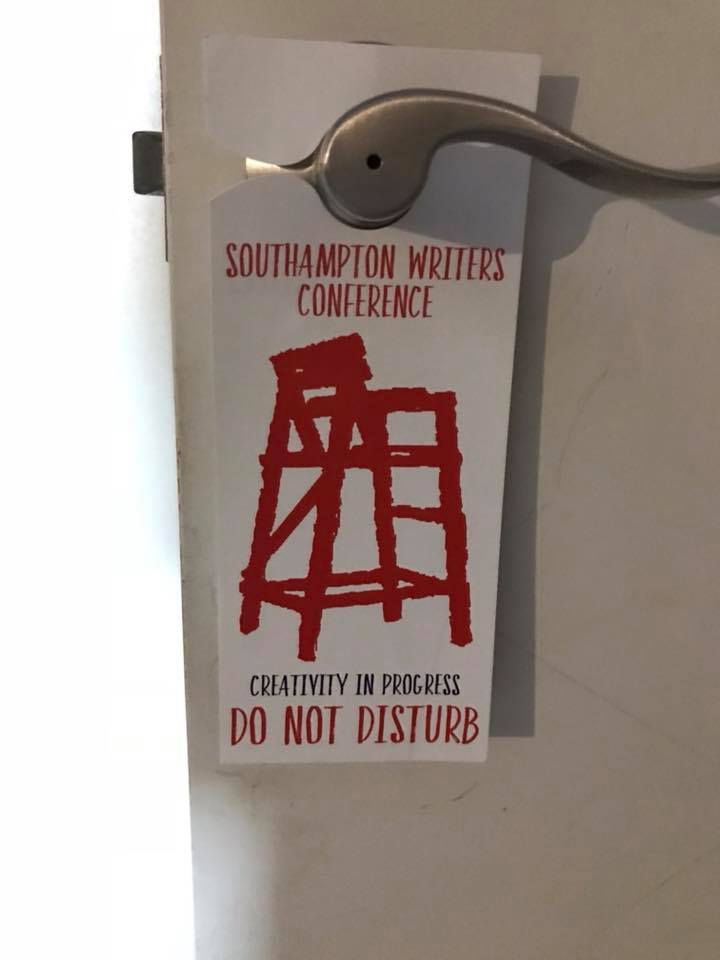
A week after I got home from Oroville, I boarded an airplane and flew to New York for the Southampton Writers' Conference and the start of the BookEnds program.

Twelve days of living in a dorm room tiny enough that the door couldn't be opened fully without banging into the dresser. Twelve days surrounded by other writers. Twelve days of panels and readings and talking about books. And twelve days of getting to know Meg Wolizter and Susie Merrell and the other eight BookEnders. It was not all peaches and cream and sweetness and light. It was a lot of hard work, stress, anxiety, and, ultimately, a breakthrough on how to get my novel to where I want it to be, plus the development of an incredible support network who will be there for me over the next year. Deadlines, accountability, phenomenal writers, and a commitment to advocate and assist and support each other in achieving the novels we want. Yes, please!

Talk about feeling like a writer again!

After the conference was over, I got to decompress at a friend's house and spent a phenomenal day in Manhattan at the Guggenheim where I reveled in the Giacometti exhibit.

I found myself fascinated with the space the artwork occupies as well as the space that surrounds it, and how my presence interacted with the artwork, hiding some facets while revealing others as I moved around the piece. It was, in visual form, a representation of everything I had been thinking about my novel and helped settle those revelations and insights deeper in my brain.

Then, I got on an airplane and came back home ready to get back to work on my novel.

So, over the next year, I plan on sharing insights on how revision happens, how it stumbles, where I completely go off the rails, successes and failures, and what the BookEnds program is like. I also hope, along the way, to give insight into what the writing life looks like and how one writer's process moves forward.


Seriously the best piece
of conference swag EVER.
Watch out, world, the Word Slut has returned.